The AI Workforce Shift, Token Economics, and the CIO’s New Mandate: Lessons from ASMPT’s Dr. Henning Borg
The conversation around artificial intelligence has moved swiftly from pilot projects to operational reality. For leaders across manufacturing, electronics, and semiconductors, the question is no longer if AI will reshape their business, but how to manage the complex, human, and financial dimensions of this transformation.
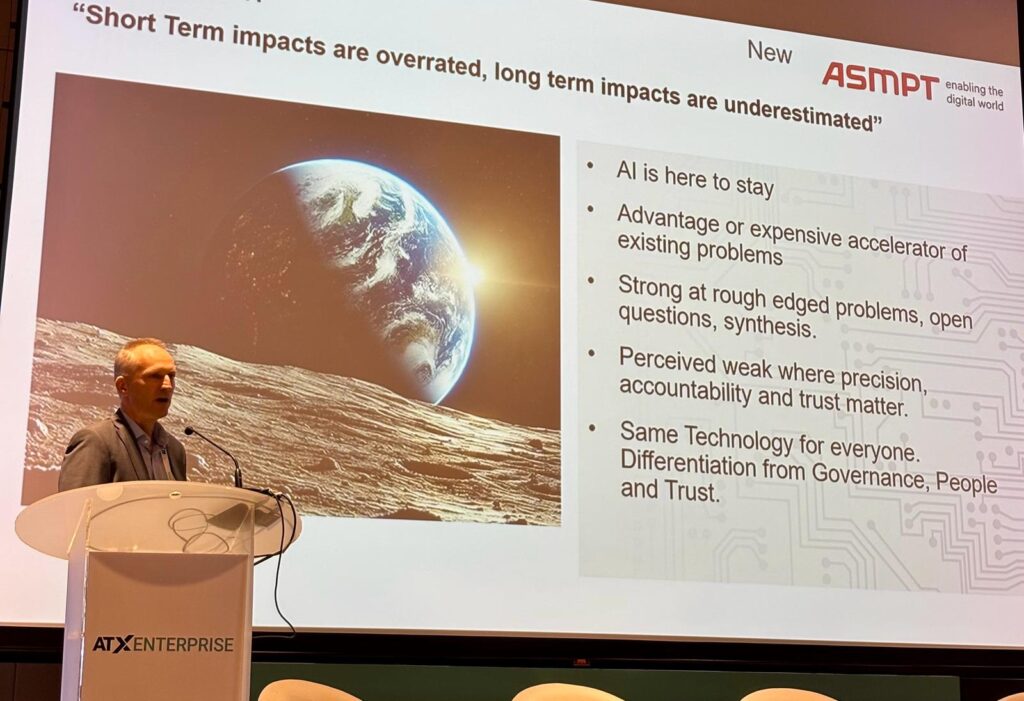
Drawing on insights from Dr. Henning Borg, Group CIO & SVP at ASMPT – delivered during his keynote at ATxEnterprise 2026 at Singapore Expo, as part of the Enterprise Tech Leaders & CISO Briefing – a fascinating picture emerges. It is one of blended workforces, emerging “super employees”, a challenging token economy, and a necessary evolution of the CIO role. The core message is clear: AI adoption is not a technology maturity journey; it is an operational model redesign that demands financial discipline, strategic leadership, and a frank reckoning with legacy risks.
The Blended Workforce Is Coming Sooner Than You Think
Within two to three years, expect the blended workforce to become commonplace. AI will range from augmenting employees to taking on fully autonomous roles. Leaders must communicate both the opportunities and the limitations of AI clearly to their teams. Resistance will mirror typical IT project pushbacks, such as those seen with new help desk tools or SAP implementations. Political or cultural inertia must be addressed early.
Rather than relying solely on top-down mandates, identify and empower change champions within the business. These internal advocates are essential to drive evolution from within.
The Rise of ‘Super Employees’ and a Hidden Cost: Stress
As AI agents proliferate, a new role is emerging: the ‘super employee’. These individuals will orchestrate AI agents and manage workflows within functional departments. They will need to know which agents exist, how they collaborate, and where new agents are required. They will supervise AI outputs and handle more parallel tasks due to augmentation.
But there is a significant human risk. Stress levels are likely to increase because these employees will manage multiple AI-supported tasks simultaneously. Sustainable adoption requires proactive awareness of workload and stress management. Leaders must prepare for this, not ignore it.
The Token Economy: Your Next FinOps Challenge
If you thought cloud cost management was tricky, wait for the token economy. Companies will need to scrutinise token usage per department and per task, analysing whether consumption delivers sufficient value. This is directly analogous to FinOps in cloud computing.
Strategies to reduce token use, such as prompt optimisation, will be necessary. Contractual negotiations to lower token expenses will become a regular task. Without this financial discipline, the very economics of AI adoption risk unravelling.
Rapid Legacy Creation: A Thousand Agents, A Thousand Risks
Here is a startling prediction. One speaker expects to create around 1,000 AI agents personally over a few years, far exceeding legacy applications from the past. This rapid legacy creation poses serious risks. AI agents and their prompts will require ongoing review, versioning, and performance tracking to avoid degradation. Model updates (e.g., versions 4.5, 4.6, 4.7) could silently impact prompt effectiveness.
A central AI governance platform is no longer optional; it is necessary to manage this evolving legacy and mitigate risk.
Leadership Must Set the AI Strategy, Not Just the CIO
Company leadership, not CIOs alone, must set the AI direction based on core innovation drivers: product development, time to market, customer focus, cost reduction, or efficiency gains. Leadership must decide whether to be a digital leader, fast follower, or late investor. Digital leaders must accept more risk and failure, but they gain competitive advantage.
Business outcomes should be the North Star. Focus on value dimensions like revenue, innovation speed, customer experience, compliance, productivity, and engagement. Gartner data shows most AI activity targets productivity, cost reduction, and customer experience, with less focus on employee engagement or risk and compliance. Revenue increase is not yet a major direct focus in many companies. That needs to change.
Funding Principles and the Evolution of the CIO Role
Funding models must link directly to expected business outcomes and strategic priorities. Investment decisions should consider long-term transformation impacts, not just short-term cost savings.
This directly feeds into the evolution of the CIO role. There are multiple possible models: platform provider, technologist, governance enforcer, or transformation manager. The CIO must shape their leadership role and organisation purposefully, moving beyond ERP or application-centred teams towards data and AI platform governance. The business retains ownership of processes and data; the CIO owns platform provisioning and governance. CIOs are encouraged to develop into change leaders, value creators, and AI platform enablers.
Data Products, Partner Networks, and Practical First Steps
On the data front, adoption of data products as standard practice is essential. Data products deliver quality-checked, cleansed data labelled clearly for easy consumption. This improves traceability. As AI agents increasingly access data autonomously, traditional data strategy importance might decline, shifting towards stronger data policies rather than rigid process controls.
Strengthening partner networks is also vital. Leverage major vendors like SAP, Salesforce, Microsoft, GitLab, and AWS for AI consumption. Build long-term, trusted relationships to accelerate implementation without building all capabilities in-house.
Generative AI and software development are must-do priorities. Adopt generative AI tools quickly, using platforms like Microsoft Copilot or AWS Cairo. Focus on practical adoption, not debate. Invest in building internal AI skills aligned with your agreed investments.
Finally, build change management competency within IT and business units. Establish governance to monitor and control AI token economy costs. Lead the organisational shift from application-centric to platform- and data-focused structures.
The age of AI is not coming; it is here. Those who manage the workforce, the tokens, and the legacy wisely will lead. Those who ignore the human and financial dimensions will struggle. Choose wisely.