
Allianz Risk Barometer 2026: Key Business Risks and Strategies for Resilience
In an era of rapid technological advancement and geopolitical shifts, understanding emerging business risks is crucial for organizations worldwide. The 15th Allianz Risk Barometer, released in early 2026, draws from the insights of 3,338 risk management experts across 97 countries and 23 industry sectors. This comprehensive survey identifies the top corporate concerns for the year ahead, highlighting how digital threats, climate impacts, and regulatory changes are reshaping the global risk landscape. Whether you’re a business leader in Singapore or elsewhere, these findings offer valuable guidance for building resilience.
Survey Methodology: A Global Perspective
The Allianz Risk Barometer incorporates views from a diverse group, including Allianz customers, brokers, industry organizations, risk consultants, underwriters, senior managers, and claims experts. Conducted in October and November 2025, the survey targeted large companies (over US$500 million in annual revenue), mid-sized firms (US$100 million to US$500 million), and smaller enterprises (under US$100 million). Respondents selected up to three key risks per industry, with rankings determined by year-on-year positions rather than percentages. This approach ensures a focus on evolving priorities, with artificial intelligence renamed from “new technologies” and talent issues from “shortage of skilled workforce” compared to 2025.
Top 10 Global Business Risks for 2026
Cyber incidents dominate as the foremost concern, cited by 42% of respondents, marking the fifth consecutive year at number one. Artificial intelligence surges to second place at 32%, reflecting its dual role as an opportunity and a threat. Business interruption follows at 29%, influenced by supply chain vulnerabilities amid geopolitical tensions.
Here’s a breakdown of the top risks:
| Rank | Risk | Percent | 2025 Rank | Trend |
|---|---|---|---|---|
| 1 | Cyber incidents (e.g., cyber crime, IT disruptions, malware/ransomware, data breaches) | 42% | 1 (38%) | → |
| 2 | Artificial intelligence (e.g., implementation challenges, misinformation, liabilities) | 32% | 10 (10%) | ↑ |
| 3 | Business interruption (incl. supply chain disruption) | 29% | 2 (33%) | ↓ |
| 4 | Changes in legislation and regulation (e.g., tariffs, new directives, sustainability requirements) | 26% | 4 (22%) | → |
| 5 | Natural catastrophes (e.g., storm, flood, earthquake, wildfire) | 21% | 3 (29%) | ↓ |
| 6 | Climate change (e.g., physical, operational, and financial risks from extreme weather) | 19% | 5 (19%) | ↓ |
| 7 | Political risks and violence (e.g., war, political instability, terrorism, civil unrest) | 15% | 9 (14%) | ↑ |
| 8 | Macroeconomic developments (e.g., inflation, deflation, monetary policies, austerity programs) | 14% | 7 (15%) | ↓ |
| 9 | Fire, explosion | 13% | 6 (17%) | ↓ |
| 10 | Market developments (e.g., intensified competition, new entrants, M&A, stagnation, fluctuation) | 13% | 8 (24%) | ↓ |
This visual overview captures the shifting priorities:
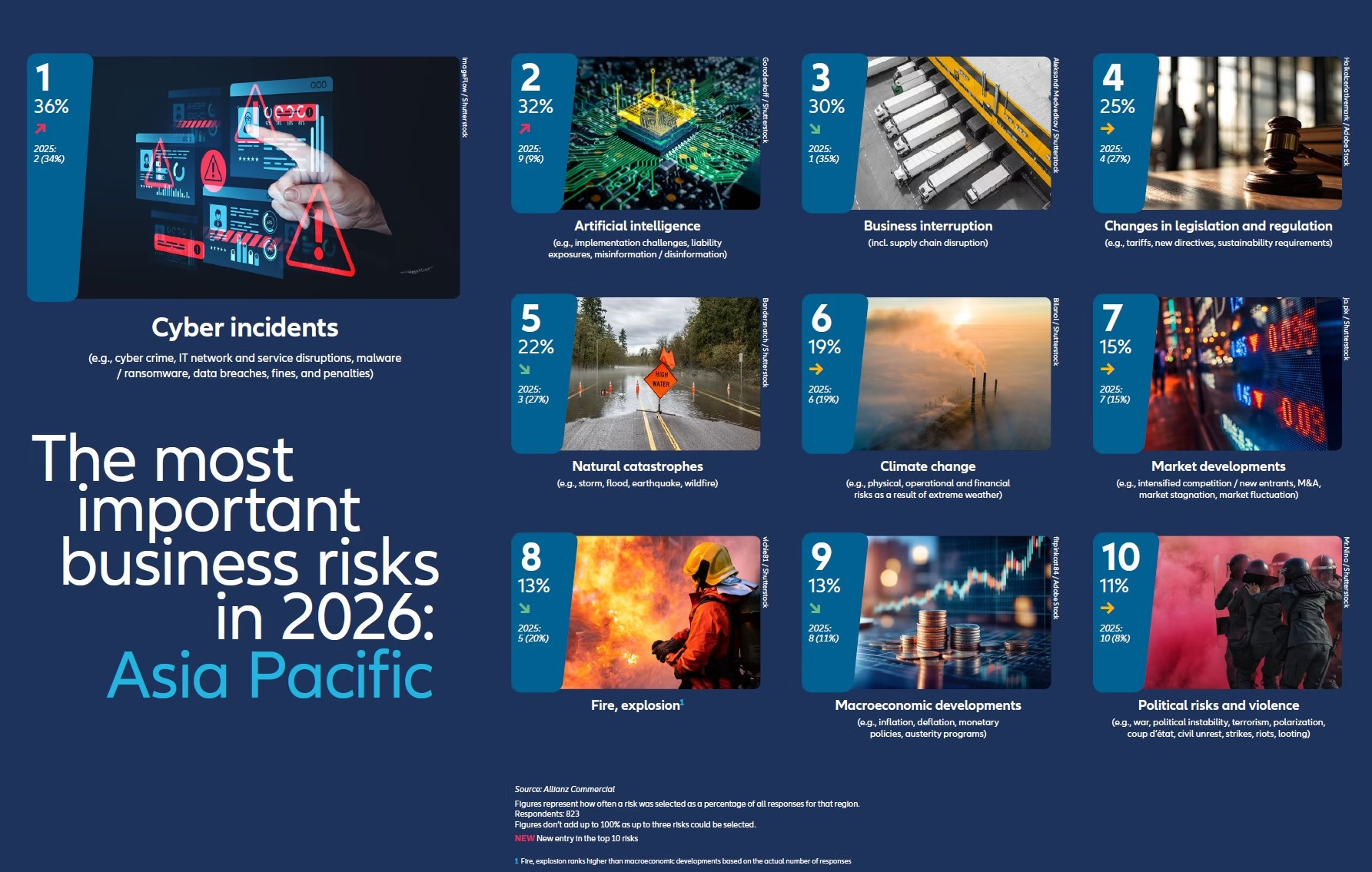
Lower-ranked risks include critical infrastructure blackouts (11th, 8%) and talent issues (12th, 8%), with biodiversity entering as a new concern at 17th (4%).
10 Key Risk Developments: Survey Snapshots
The report provides snapshots of evolving risks. Cyber incidents lead by a 10% margin, driven by AI-enhanced threats and third-party dependencies. AI’s rise underscores its integration into operations, with nearly half of respondents seeing more benefits than risks; companies are prioritizing education and upskilling.
Business interruption remains tied to geopolitics, with only 3% viewing supply chains as very resilient. Regulatory changes, fueled by tariffs and diverging global rules, prompt market exploration and supply chain diversification. Natural catastrophes and climate change drop slightly, yet insured losses topped US$100 billion for the sixth year.
Political risks climb to seventh, with war as the top worry; a global supply chain paralysis is seen as a likely black swan event. Macroeconomic resilience hides complexities like AI acceleration and debt pressures, forecasting rising insolvencies. Fire and market developments round out the top 10, with caution around AI bubbles.
As risks interconnect, integrated strategies like horizon scanning and AI-aided modeling are essential for adaptation.
Top Concerns Around the World
Risks vary by region. In Singapore, business interruption tops the list, followed by cyber and AI. Globally, cyber leads in 20 countries, including the US, UK, and India. AI emerges as number one in Australia, Brazil, and Colombia.
This map illustrates regional variations:
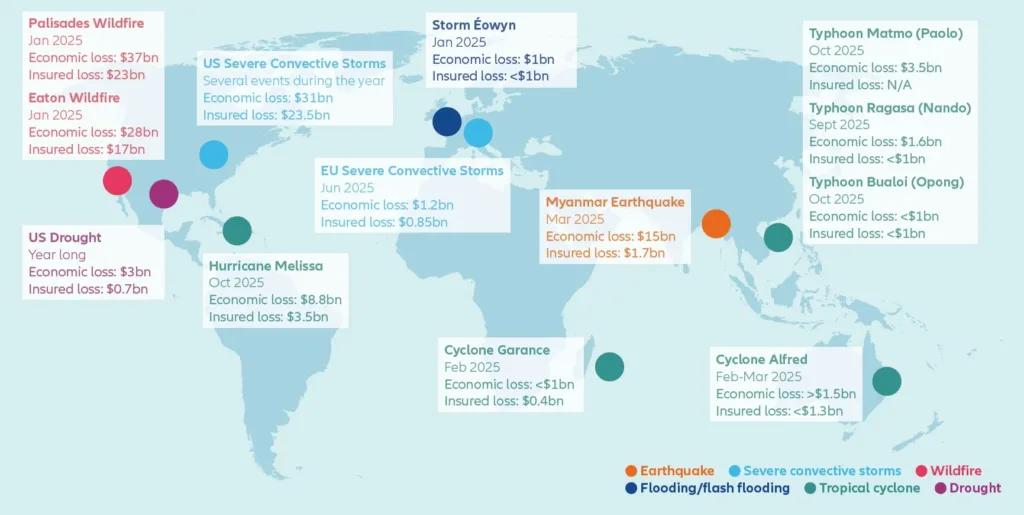
In Asia Pacific, AI and macroeconomic developments are rising concerns, while Europe emphasizes cyber and regulatory shifts.
Overview of Top Global Risks
The barometer emphasizes interconnected perils. Cyber tops amid AI and supply chain pressures, viewed as a complex operational, legal, and reputational issue. Geopolitical factors strain supply chains, deemed very resilient by just 3%. Resilience strategies, bolstered by AI, are key to navigating these.
Quote from Michael Bruch, Global Head of Risk Consulting Advisory Services: “Those businesses that can develop integrated risk management and resilience strategies, that are forward-looking, strategic and functional, and agile enough to adapt to rapid change, will be best placed to capture opportunities.”
Deep Dive: Cyber Incidents as the Leading Risk
Cyber ranks first in multiple regions and company sizes. Its history shows a steady climb since 2021.
This chart tracks its trajectory:
AI amplifies threats, with organizations reliant on third parties. Quote from Rishi Baviskar: “Organizations are increasingly reliant on third party providers for critical data and services, while AI is supercharging threats.”
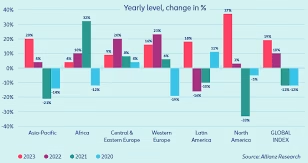
Investment in protection is high, with 90% planning moderate (47%) or high (43%) spending.
This bar chart shows anticipated investment levels:
Conclusion: Building Resilience in Uncertain Times
The Allianz Risk Barometer 2026 reveals a world where digital and geopolitical risks dominate, urging proactive measures. By investing in cyber defenses, diversifying supply chains, and leveraging AI for risk management, businesses can turn challenges into opportunities. Stay informed and adapt to thrive in 2026.