SolatGoWhere: No App, No Fame – Building a Prayer Space Directory for Muslims in Singapore
The developer behind SolatGoWhere requested to remain anonymous. In an interview, they explained that the goal is to shift attention away from any individual and onto the community tool itself: a locally focused directory of prayer spaces and Muslim-friendly venues in Singapore.
From a Dinner Conversation to a Live Directory
The idea didn’t come from a grand struggle. It started during dinner with friends. The restaurant had a musolla, so prayer wasn’t an issue, but the group began wondering: what other Muslim-friendly restaurants in Singapore have prayer spaces? That question led to a simple observation. Existing directories were mostly static listings. They depended entirely on a single admin to update information. If that admin was unavailable, the data quickly became outdated.
A Community-Driven Verification Model
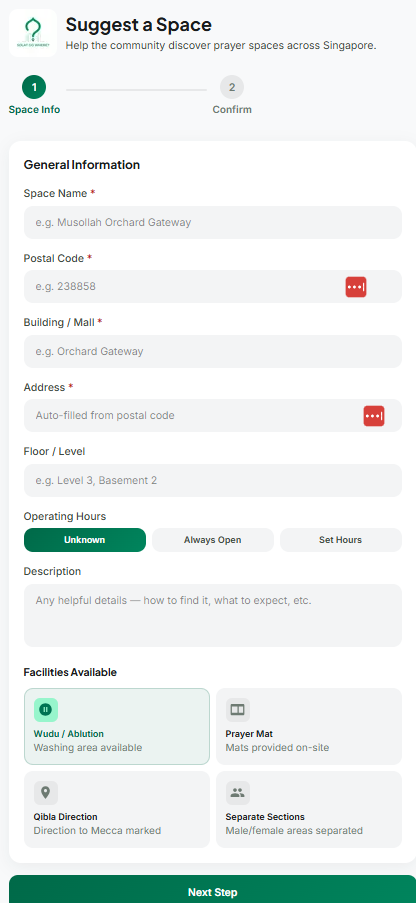
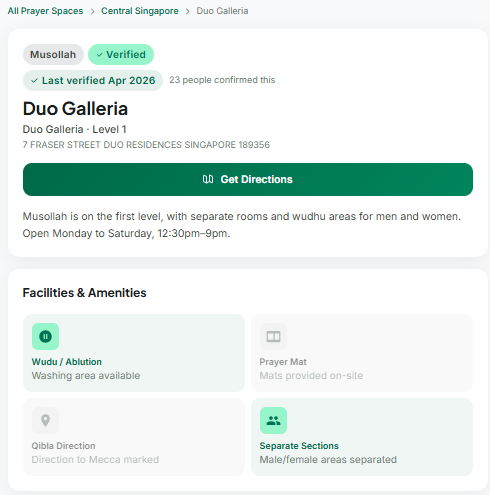
The solution was to flip the workflow. On this directory, anyone can add a listing, but it starts as unverified. When enough users visit a place and verify it, the status changes to verified automatically. The same logic applies to reports; if a place closes or changes, users can flag it, and the listing switches to “needs review.” This reduces reliance on one person.
On top of the community layer, the developer manually reviews flagged entries via an admin dashboard. They also check external sources, like TikTok, to confirm legitimacy. Fake or prank submissions are caught through this combination of community reporting and admin oversight.
Operational Reality
The admin dashboard works on a mobile browser. It includes an audit log that tracks verifications, comments, and reports. The developer considered a Telegram bot for automation, but given the current activity level, it is not necessary. They have not reached out to the teams behind competing websites and apps, but have contacted schools and Muslim societies, most of whom had no issue with the listings.
Built by AI, No Coding Required
The developer has a background in psychology and works as a product manager with eight years of experience. They have no technical skills. The entire site was built using AI tools: Claude as the developer, and Perplexity as the marketing officer. The tech stack includes Next.js, Vercel, Supabase, and GitHub. These were chosen for their free capabilities and low resource consumption, keeping the site lightweight and fast on mobile data. If they were to rebuild the site tomorrow, they would consult Claude again on cost efficiency.
Launching Anonymously on Threads
Remaining anonymous created unexpected hurdles. The developer initially tried to launch on TikTok but ended up in “TikTok jail”. They pivoted to Threads, which turned out to be an active platform for the Muslim community in Singapore and Malaysia.
The Most Requested Feature: Photos
If they could add one feature tomorrow, it would be image uploads for prayer spaces. Photos would boost user confidence. However, this comes with considerations: hosting costs, bandwidth, and the risk of inappropriate images. The developer is still exploring solutions, including where to host the images without hurting performance.
No App, Less Friction
Some users have asked why there is no iOS or Android app. The answer is deliberate: a website removes the friction of a download. Everyone uses a web browser. The site is mobile responsive and can be saved as an icon on a phone, mimicking an app. The developer plans to create social media content teaching users how to do that.
Staying Local, Not Global
The domain uses .com, but that was a matter of cost and availability, not a sign of expansion plans. The use case is uniquely Singaporean. In Singapore, malls rarely have official prayer room signs, unlike Malaysia where every mall and government building has a surau sign. For now, there are no plans to expand beyond Singapore. The volume would be too much to handle, and the product has a distinctly Singaporean flavour.
The developer’s motivation is simple: after eight years of building profit-driven products at work, this feels like a legitimate community use case. That is what keeps the project going, with or without public credit.
For more information, do check out https://solatgowhere.com